

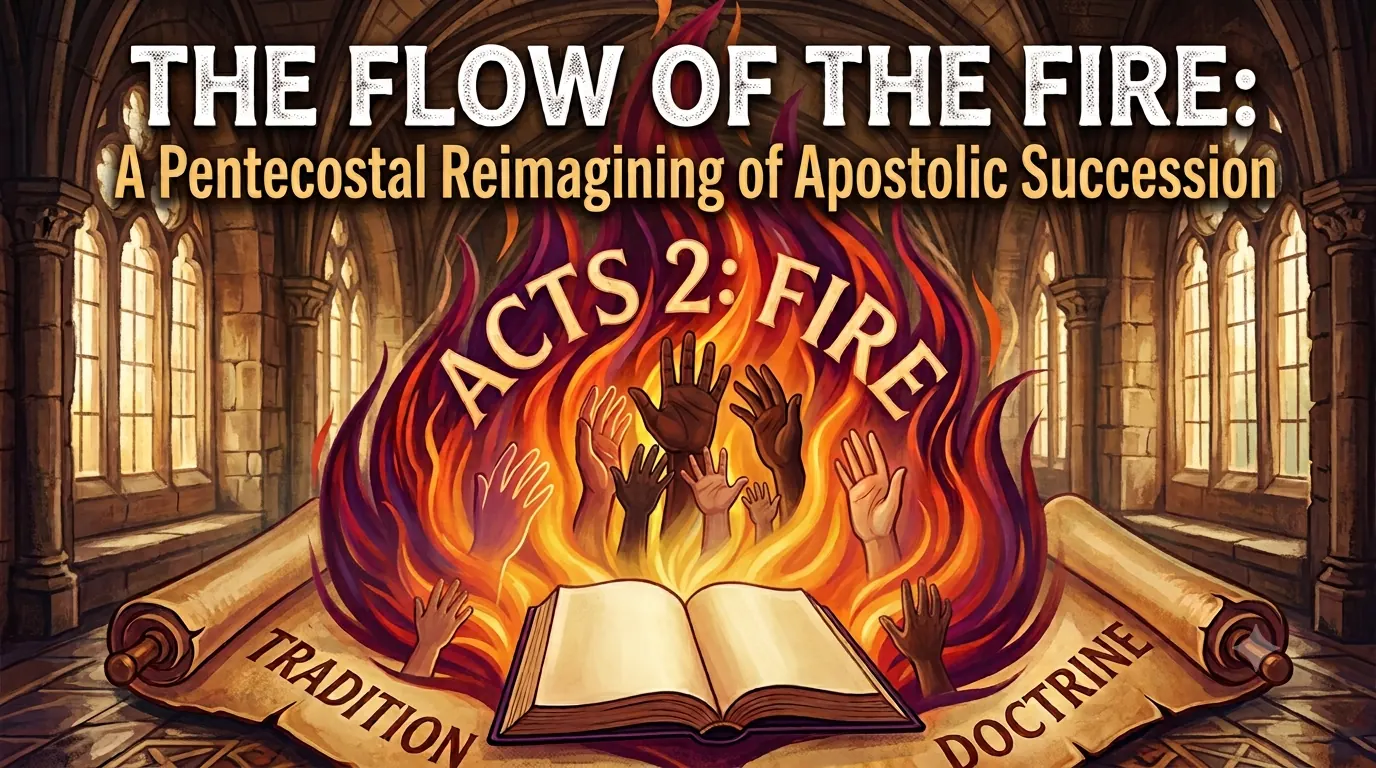
For centuries, the concept of apostolic succession has been defined by a paper trail and a physical touch. In high-church traditions, it is an unbroken chain of custody: an apostle lays hands on a bishop, who lays hands on the next bishop, stretching from first-century Rome down to the clergy of today. If the chain breaks, the authority vanishes.
But from a Pentecostal viewpoint, this structural definition misses the entire point of what an apostle actually is. True apostolic succession is not a pedigree of flesh and politics; it is a succession of faith, truth, and the fire of the Holy Spirit.
1.The Missing Bishops of the First Century
The historical argument for a strict, top-down episcopal line collapses under the weight of early church history and the New Testament itself.
When we read the book of Acts and the Pauline epistles, the structural landscape of the church is fluid and localized. The apostles didn't ordain "bishops" (episkopos) as a distinct, superior order of clergy over ordinary congregations. Instead, they ordained elders (presbyteros) to lead local assemblies. In the New Testament, "bishop" (overseer) and "elder" (presbyter) are used interchangeably (as seen in Titus 1:5-7 and Acts 20:17-28). There was no single, monarchical bishop ruling over a city.
This is especially clear when looking at the early church in Rome. Despite later traditions constructing a neat, linear list of popes starting with St. Peter, historical and textual evidence shows no record of a single monarchical bishop in Rome until near the end of the second century.
Early documents like 1 Clement (written from Rome around 96 AD) and the writings of Justin Martyr (mid-second century) describe the Roman church as being led by a collegiate body of elders or a "president" of the assembly, rather than a solitary bishop. The highly structured hierarchy came later, born out of a human need for organization and structural defense against early heresies.
2.The Upper Room Was the Real Ordination
If the succession isn't passed down via an ecclesiastical hierarchy, where does apostolic authority come from?
To find the true "ordination" of the church, we have to look past institutional titles and return to Mark's Upper Room in Acts 2.
Before Pentecost, the disciples had chosen Matthias to replace Judas, trying to maintain a physical, organizational twelve. Yet nothing happens when they cast lots. The true birth, validation, and ordination of the global apostolic movement occurred when the Holy Spirit fell as tongues of fire.
The anointing of the Holy Spirit is the ordination. The apostles were defined not by a seat of office, but by their acts — by the supernatural empowerment to preach the gospel, heal the sick, and expand the borders of the Kingdom.
3.The Re-emergence of the Fire: From Reformation to Azusa
From a Pentecostal historical perspective, this spiritual line of succession did not die out; it was simply buried under centuries of institutional clutter.
The Protestant Reformation acted as the crucial precursor, digging up the foundational truth of Sola Scriptura (Scripture alone) and the priesthood of all believers. It restored the doctrine of the apostles.
But the full restoration of the power of the apostles required a direct spiritual successor to Acts 2. That arrived in 1906 at the Azusa Street Revival in Los Angeles.
Just as in the Upper Room, a diverse group of believers gathered, laid aside human-made ecclesiastical structures, and sought the direct filling of the Holy Spirit. What followed was an explosion of tongues, prophecy, and miraculous healings that birthed the modern Pentecostal movement. Azusa Street proved that apostolic succession isn't caught from an institutional hand; it is caught from the heavenly wind. True succession is following the teachings of the apostles and walking in their supernatural acts.
Safeguarding the Flame: Wisdom for the Pentecostal Walk
While we anchor our authority in the raw, sovereign movement of the Holy Spirit, walking this path requires deep spiritual maturity. A movement built on spiritual fire must always be careful of two critical pitfalls:
The Danger of Radical Subjectivism
When we rightfully decouple authority from institutional chairs and anchor it in spiritual experience, we must step carefully. If authority is reduced purely to "the Spirit told me," the door swings open to rogue leadership and doctrinal drift. Spiritual experiences must always remain subordinate to, and tested by, the unchanging yardstick of Holy Scripture.
The Necessity of Knowing Tradition
Pentecostalism should never avoid or ignore the historical tradition of the broader Church. Early church fathers like Irenaeus didn't develop early structures just for politics; they did it to safeguard the core truths of the gospel against early heresy. Knowing our roots, historical creeds, and church history keeps the modern movement grounded, ensuring we don't accidentally isolate ourselves or repeat ancient theological mistakes in the name of novelty.
Keep reading
You Are HIS Masterpiece — if the fire of the Spirit is what marks the Church, what does it say about the worth of the person carrying it? Br. Binu Baby on Ephesians 2:10 and where our value actually rests. Or browse all articles from the MERC pulpit.